Febrile seizures (fever fits) in children
A fit during fever is common in young children and usually harmless, though it is alarming to see. Learn what to do and when to seek help.
This can be an emergency
If a seizure with fever lasts more than 5 minutes, or the child stays drowsy, has a stiff neck, a rash or difficulty breathing, call 108 or go to the nearest emergency department.
What is a febrile seizure?
A febrile seizure is a fit that happens in a child with a fever, without an infection of the brain itself. It typically affects children between 6 months and 5 years of age. Around 2 to 5 in every 100 children have at least one. The young brain is more sensitive to fever, and the tendency often runs in families.
Doctors describe two kinds. A simple febrile seizure involves the whole body, lasts less than 15 minutes (usually only a minute or two) and does not recur within 24 hours. A complex febrile seizure lasts longer than 15 minutes, affects one side of the body or happens more than once in the same illness.
Simple febrile seizures do not damage the brain and do not affect intelligence or development. About one child in three will have another during a later fever. They are outgrown, usually by the age of five or six. Febrile seizures are not epilepsy, and the great majority of these children never develop it.
Febrile seizure symptoms
Common symptoms
- Loss of consciousness during a fever
- Stiffening followed by jerking of the arms and legs
- Eyes rolling upwards
- Sleepiness or irritability for up to an hour afterwards
- A fever that may only be noticed after the fit
Less common symptoms
- Jerking of only one side of the body
- A seizure lasting longer than 15 minutes
- More than one seizure in 24 hours
- Weakness of an arm or leg for a short time afterwards
- Vomiting or passing urine during the seizure
Get emergency help now if
- The seizure lasts more than 5 minutes
- The child is under 6 months old
- The child remains very drowsy, floppy or confused after an hour
- There is a stiff neck, a rash that does not fade, repeated vomiting or a bulging soft spot
- The child has difficulty breathing
Call our 24-hour emergency line on 040 4189 4777, or call 108 for an ambulance. Do not wait for an appointment.
These symptoms have many possible causes. Having one or more of them does not confirm a diagnosis. A doctor needs to examine you to find the cause.
Causes and risk factors
The seizure is triggered by fever, most often from an ordinary viral infection such as a cold, an ear infection or a stomach bug. Fever after a vaccination can occasionally trigger one. The seizure can occur as the temperature rises, sometimes before parents know the child is unwell.
Some children are more prone than others.
Factors that make recurrence more likely
- Age between 6 months and 5 years, most often 12 to 18 months
- A parent, brother or sister who had febrile seizures
- A first febrile seizure before 18 months of age
- A seizure occurring with a relatively low fever
- Frequent febrile illnesses, for example in day care
How febrile seizures are assessed
The doctor's main task is to find the cause of the fever and to make sure there is no infection of the brain. After a typical simple febrile seizure in a child who has recovered fully, few tests are needed.
- History and examination
- A description of the seizure and a check of the ears, throat, chest and nervous system.
- Tests for the source of fever
- Blood or urine tests when the cause of the fever is not obvious.
- Lumbar puncture
- Advised if there are signs of meningitis, or in young infants where such signs are hard to detect.
- EEG
- Not routinely needed after a simple febrile seizure. May be requested after complex or repeated seizures.
- MRI scan of the brain
- Not routinely needed. Considered after a prolonged or one-sided seizure, or if the examination is abnormal.
This list describes tests that doctors commonly use. CT, MRI, EEG and nerve conduction studies are available on site at Siddarth Neuro Hospital. For other tests, please call the hospital to confirm availability.
Treatment and care for febrile seizures
Most febrile seizures stop on their own within a few minutes and need no specific treatment. Care focuses on the illness causing the fever and on preparing parents for any future episode.
- First aid
- Place the child on their side, keep the airway clear and time the seizure. Do not put anything in the mouth and do not give a bath during the fit.
- Treating the fever
- Fever medicine and fluids keep the child comfortable. They have not been shown to prevent febrile seizures, so parents should not blame themselves if one occurs.
- Treating the infection
- Antibiotics are used only when a bacterial infection is found.
- Rescue medicine
- Some children who have had prolonged seizures are given an emergency medicine for parents to use at home.
- Daily preventive medicine
- Rarely needed. Regular anti-seizure medicine is generally not recommended for simple febrile seizures, because the side effects outweigh the benefit.
- Follow-up
- A review with a pediatric neurologist is useful after complex or frequent febrile seizures, or if there are concerns about development.
No treatment can guarantee a particular result. Your doctor will explain the expected benefits and risks of each option for your situation.
Would you like to discuss febrile seizures with a specialist?
When to see a pediatric neurologist
Book a consultation if any of these apply to you or a family member.
- The seizure was prolonged, one-sided or repeated within a day
- Your child has had several febrile seizures
- A seizure has occurred without fever
- Your child's development is delayed
- Febrile seizures continue after the age of six
- You would like guidance on managing future episodes at home
Do not book online for an emergency
If symptoms are sudden or severe, or match the emergency signs listed above, an appointment is not the right route. Call our 24-hour emergency line on 040 4189 4777, or call 108 for an ambulance. Do not wait for an appointment.
Why choose Siddarth Neuro Hospital?
Siddarth Neuro Hospital is a specialty hospital in Miyapur, Hyderabad, focused on conditions of the brain, spine and nerves. It is NABH accredited and has a NABL accredited laboratory. It has a round-the-clock emergency room and a 24-hour emergency stroke care unit. Children with complex or repeated febrile seizures are seen by a neurologist with fellowship training in pediatric neurology.
At a consultation, the doctor listens to your history, examines you and explains which tests, if any, are needed. You leave with a clear plan for treatment and follow-up. Family members are welcome to attend and ask questions.
Facilities at the hospital
- Emergency room
- Open 24 hours, 7 days a week.
- Emergency stroke care unit
- Receives stroke patients at any hour.
- CT scanner on site
- Brain and spine CT scans are done in the hospital, without transfer to another centre.
- MRI scanner on site
- Detailed imaging of the brain, spine and nerves in the same building.
- EEG
- Recording of the brain's electrical activity, used in the assessment of seizures and epilepsy.
- Nerve conduction studies
- Tests of how well the nerves carry signals, used for numbness, tingling and weakness.
- Intensive care unit
- ICU beds for patients who need close monitoring.
- Operating theatres
- For brain and spine surgery.
- Neuronavigation unit
- A computer-guided system that uses the patient's scans to help the surgeon plan and locate the target precisely during brain and spine surgery.
- Rehabilitation and therapy
- Physiotherapy, occupational therapy and speech therapy for recovery after illness, injury or surgery, and for children with developmental needs.
Treatments and procedures available
- Stroke care
- Comprehensive care from emergency assessment in the stroke unit through to rehabilitation and prevention of further strokes.
- Epilepsy management
- Diagnosis with EEG and imaging, and long-term treatment for adults and children.
- Brain tumour resection
- Surgery to remove tumours of the brain, planned with MRI and neuronavigation.
- Micro-neurosurgery
- Operations on the brain, spine and nerves performed under an operating microscope.
- Deep brain stimulation
- A surgical treatment for selected patients with Parkinson's disease, tremor or dystonia.
- Minimally invasive spinal reconstruction
- Spine surgery through small incisions to relieve nerve pressure and stabilise the spine.
Whether a procedure is suitable depends on an individual assessment by the specialist.
Accreditations
- NABH
- Accredited by the National Accreditation Board for Hospitals and Healthcare Providers, which assesses hospitals on patient safety and quality of care.
- NABL
- Laboratory accredited by the National Accreditation Board for Testing and Calibration Laboratories, which assesses the accuracy and reliability of laboratory testing.
Our pediatric neurology specialist
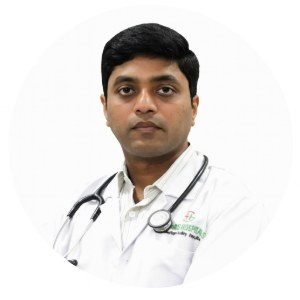
Dr. T. Siddarth Reddy
Founder and Managing Director, Senior Consultant Neurologist
- Qualifications
- MBBS, MD, DM (Neurology, Gold Medalist), Fellowship in Pediatric Neurology (Texas, USA)
- Specialty
- Adult and paediatric neurology
- Registration no.
- 61730
- OPD hours
- Monday to Saturday, 11 am to 8 pm
Questions patients ask about febrile seizures
Are febrile seizures dangerous?
Simple febrile seizures are not dangerous. They do not cause brain damage, learning difficulties or death. They are distressing to watch, but children recover completely.
Will my child develop epilepsy?
The risk is only slightly higher than for other children. It rises somewhat if the seizures were complex, if there is a family history of epilepsy or if development was already delayed. Most children with febrile seizures never have epilepsy.
Can I prevent febrile seizures by controlling the fever?
Fever medicine makes a child more comfortable but studies show it does not reliably prevent febrile seizures. Give it for comfort, keep the child lightly dressed and offer fluids.
Should I put a spoon or my finger in my child's mouth?
No. A child cannot swallow the tongue. Objects in the mouth can break teeth or block breathing. Turn the child on their side instead.
Should my child still have vaccinations?
Yes. Vaccines protect against serious infections, including some that cause meningitis. A fever after vaccination can occasionally trigger a febrile seizure, but this is not a reason to avoid vaccines. Discuss any concern with your doctor.
Does my child need an EEG or a brain scan?
Usually not. After a simple febrile seizure with full recovery, these tests do not change the care. They are considered after prolonged, one-sided or repeated seizures.
Need a pediatric neurology consultation?
Speak with the hospital team about appointments and available specialist consultations.
- Phone
- 040 4189 4777
- Address
- Siddarth Neuro Hospital
Mythri Nagar, Madeenaguda, Miyapur
Hyderabad, Telangana - OPD hours
- Dr. T. Siddarth Reddy: Monday to Saturday, 11 am to 8 pm
Dr. Naveen Reddy V: Monday to Saturday, 10 am to 6 pm - Emergency
- Emergency room and emergency stroke care unit open 24 hours, 7 days a week
- Accreditation
- NABH accredited hospital, NABL accredited laboratory
Further reading
Medically reviewed by Dr. T. Siddarth Reddy, Senior Consultant Neurologist (MBBS, MD, DM (Neurology, Gold Medalist), Fellowship in Pediatric Neurology (Texas, USA)), on 19 November 2026.
This page gives general information for patients and families. It is not a diagnosis and does not replace a consultation. Symptoms alone cannot confirm a condition, and treatment depends on an individual assessment by a qualified doctor.